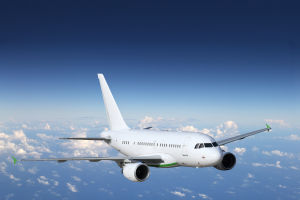
Turbulence is a natural atmospheric phenomenon produced by irregular and rapidly changing airflow.
When an aircraft encounters variations in wind speed, direction, or vertical motion, its movement can change briefly, creating the familiar sensations of bumps, jolts, or changes in altitude.
These conditions arise from several interacting processes, including convection, wind shear, mountain waves, and atmospheric stability.
What Is Atmospheric Turbulence?
Turbulence occurs when airflow becomes irregular rather than remaining relatively smooth and organized. Within turbulent flow, air can form swirling structures called eddies, producing fluctuations in velocity and pressure across different scales.
An aircraft responds to these variations through its aerodynamic forces. Changes in the airflow around its wings and other surfaces can alter lift and acceleration, resulting in temporary changes in motion.
Convection Drives Vertical Currents
Convection begins when the Earth's surface receives uneven heating. Air warmed near the surface becomes less dense and rises, while surrounding air moves to replace it. This creates vertical circulation within the atmosphere.
Strong convection can produce powerful updrafts and downdrafts, generating significant variations in airflow. Convective clouds and thunderstorms are particularly associated with intense vertical motion because of the large energy exchanges occurring within them.
Wind Shear Alters Airflow
Wind shear occurs when wind speed or direction changes substantially over a relatively short distance. These changes can occur between atmospheric layers or across horizontal boundaries.
Strong wind gradients can contribute to turbulent conditions as air moving at different speeds or directions interacts. Wind shear is therefore an important factor in understanding how atmospheric flow changes with altitude and location.
Mountains Create Atmospheric Waves
Terrain can reshape the movement of air. When strong winds encounter a mountain range, the airflow is forced upward and may develop a series of oscillating waves downstream.
These mountain waves can extend considerable distances from the terrain that generates them. Under suitable atmospheric conditions, the waves can become sufficiently disturbed to produce areas of turbulence.
Clear-Air Turbulence
Turbulence does not require visible clouds. Clear-air turbulence can develop in apparently cloudless regions where atmospheric conditions contain strong wind gradients or other rapid changes in airflow.
It is frequently associated with regions of pronounced upper-level wind variation. Because no obvious cloud formation may reveal its presence, identifying these conditions depends on atmospheric measurements, aircraft observations, and numerical weather models.
Atmospheric Stability Matters
Atmospheric stability determines how air behaves after being displaced vertically. In a stable atmosphere, displaced air tends to move back toward its original level. In an unstable atmosphere, vertical motion can continue more readily.
Stability interacts with temperature differences, moisture, wind patterns, and terrain. These relationships influence whether vertical currents remain relatively organized or become more irregular.
Measuring Turbulence
Scientists study turbulence using atmospheric observations, aircraft measurements, and numerical weather models. These methods examine variables such as wind speed, wind direction, temperature, atmospheric stability, and vertical wind gradients.
A key quantitative measure is the eddy dissipation rate, which describes the rate at which turbulent kinetic energy is dissipated. It provides a standardized way to characterize turbulence intensity and can support atmospheric analysis and forecasting.
Aircraft measurements provide additional information about the location, altitude, intensity, and duration of turbulent conditions. Combining these observations with atmospheric models helps researchers identify patterns and improve prediction methods.
How Turbulence Affects Aircraft Motion
An aircraft continuously interacts with the surrounding air. When it enters a region of rapidly changing airflow, the aerodynamic forces acting on it also change.
Variations in lift and acceleration can produce temporary vertical or horizontal movements. Passengers may experience these changes as shaking, bouncing, or a sensation of rising or descending.
The aircraft's response is therefore a direct consequence of changing atmospheric flow interacting with its aerodynamic characteristics.
A Complex Atmospheric Process
No single mechanism explains every instance of turbulence. Convection, wind shear, mountain waves, atmospheric stability, and strong upper-level wind gradients can each contribute under different conditions.
Their effects also vary with altitude, location, temperature, and the broader structure of the atmosphere. Turbulence is consequently best understood as the result of interacting atmospheric processes rather than one isolated cause.
Turbulence is a complex expression of atmospheric fluid dynamics. Uneven heating drives convection, wind shear produces rapid changes in airflow, mountains generate atmospheric waves, and stability influences how vertical motion develops.
By combining observations, aircraft measurements, and numerical models, scientists can better understand these processes and improve turbulence detection and forecasting. The movement felt inside an aircraft is ultimately a visible consequence of the atmosphere's constantly evolving physical structure.